Design and Development of a Soft Robotic Morphing Wing for Fixed-wing UAVs
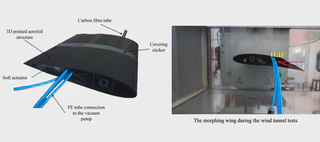
Improving performance and efficiency has long been a central objective in the design of Unmanned Aerial Vehicles (UAVs). One emerging solution is the use of morphing aerofoils, which adapt their shape in response to varying flight conditions, thereby reducing drag and enhancing aerodynamic efficiency. This concept is inspired by the biomimetic behaviour of birds, which continuously modify their aerodynamic profile as they fly. The terms “morph” and “morphing” originate from the Greek words “meta” (change) and “morphe” (form). The Wright Brothers first applied wing warping, imitating avian flight, in early aviation, but the complexity and cost of adaptive wings at the time led to the adoption of simpler control surfaces such as ailerons, elevators, and flaps. With advancements in modern materials and manufacturing technologies, interest in morphing-wing concepts has re-emerged.
Conventional wings with discrete control surfaces experience aerodynamic losses due to flow separation caused by surface discontinuities. Morphing wings, however, provide continuous surfaces and the ability to reshape in flight, allowing optimised aerodynamic profiles for different operating conditions. Such adaptability improves control efficiency and can reduce drag by as much as 40% when compared with traditional deflected ailerons. These improvements may lower fuel consumption by 18–20% for fixed-wing aircraft due to reduced drag. As a result, morphing wings offer substantial advantages over conventional flap-based designs.
Extensive research has been conducted on morphing-wing structures, actuation strategies, and material systems aimed at enhancing aircraft aerodynamic performance. Barbarino et al. presented a comprehensive review of over 300 studies on morphing technology, while Chu et al. surveyed morphing-aircraft configurations, dynamic modelling approaches, and provided valuable technical insights for future UAV and morphing-wing development. Despite these advancements, realising intelligent morphing aircraft still poses significant challenges.
The study focuses on small fixed-wing UAVs operating at low Reynolds numbers (below 500,000) through the design, numerical simulation, and experimental evaluation of a soft pneumatic actuator developed specifically for aerofoil morphing. The primary aim is to demonstrate the feasibility of soft-actuation technologies in achieving meaningful aerofoil deformation and to assess their influence on aerodynamic performance.

