Development of Computational and Experimental Framework for Small-Scale Wind Turbines
Wind energy is a widely adopted renewable energy source, with utility-scale wind turbine technology now mature and globally established. In contrast, Small-scale Wind Turbines (SWTs) remain in a developing stage, as their significantly smaller rotor area results in reduced power extraction. Improving aerodynamic efficiency is therefore essential to justify their construction and operational costs. Since turbine efficiency is strongly influenced by rotor aerodynamics, particularly blade performance, understanding how blade parameters affect overall output is crucial for advancing SWT design.
SWTs offer strong potential for distributed power generation in remote locations and can encourage private-sector participation in electricity production. For countries such as Sri Lanka, they represent a promising pathway toward decentralised renewable energy. However, Sri Lanka currently lacks both a technological foundation and active development projects for SWT implementation. Establishing technical feasibility within the country is therefore a critical first step.
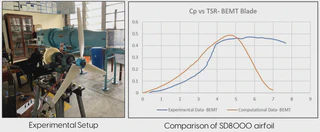
This project developed a computational framework to support the aerodynamic design and performance evaluation of SWTs. The framework enables flexible modification of design parameters and provides insights into performance variations, ultimately identifying the optimal configuration for specified design conditions. Localised challenges, such as material limitations and manufacturing constraints, are also incorporated into the design process. Additionally, an experimental setup was fabricated to measure key performance characteristics, which will be used to validate the computational predictions. An economic feasibility assessment will further identify suitable environments for effective SWT deployment, contributing to both the technical and economic justification for SWT development in Sri Lanka.

